By role
Three people, one platform
The planner, the supply-chain leader, and IT and data each need a different thing from planning software. Here is what each one gets, and the mechanism behind it, because a promise without a mechanism is an adjective.
For the planner
Your judgement is an input, not an override.
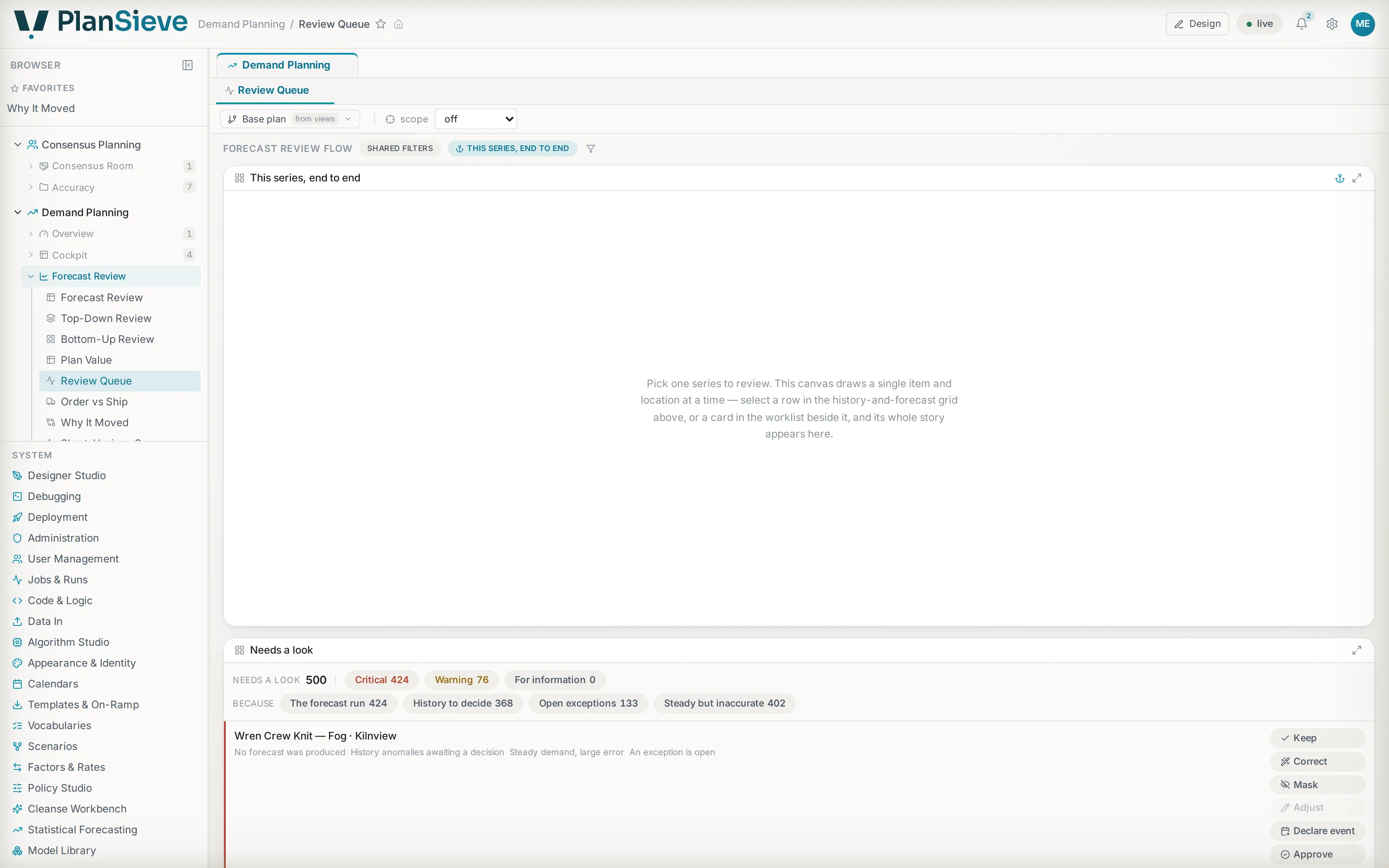
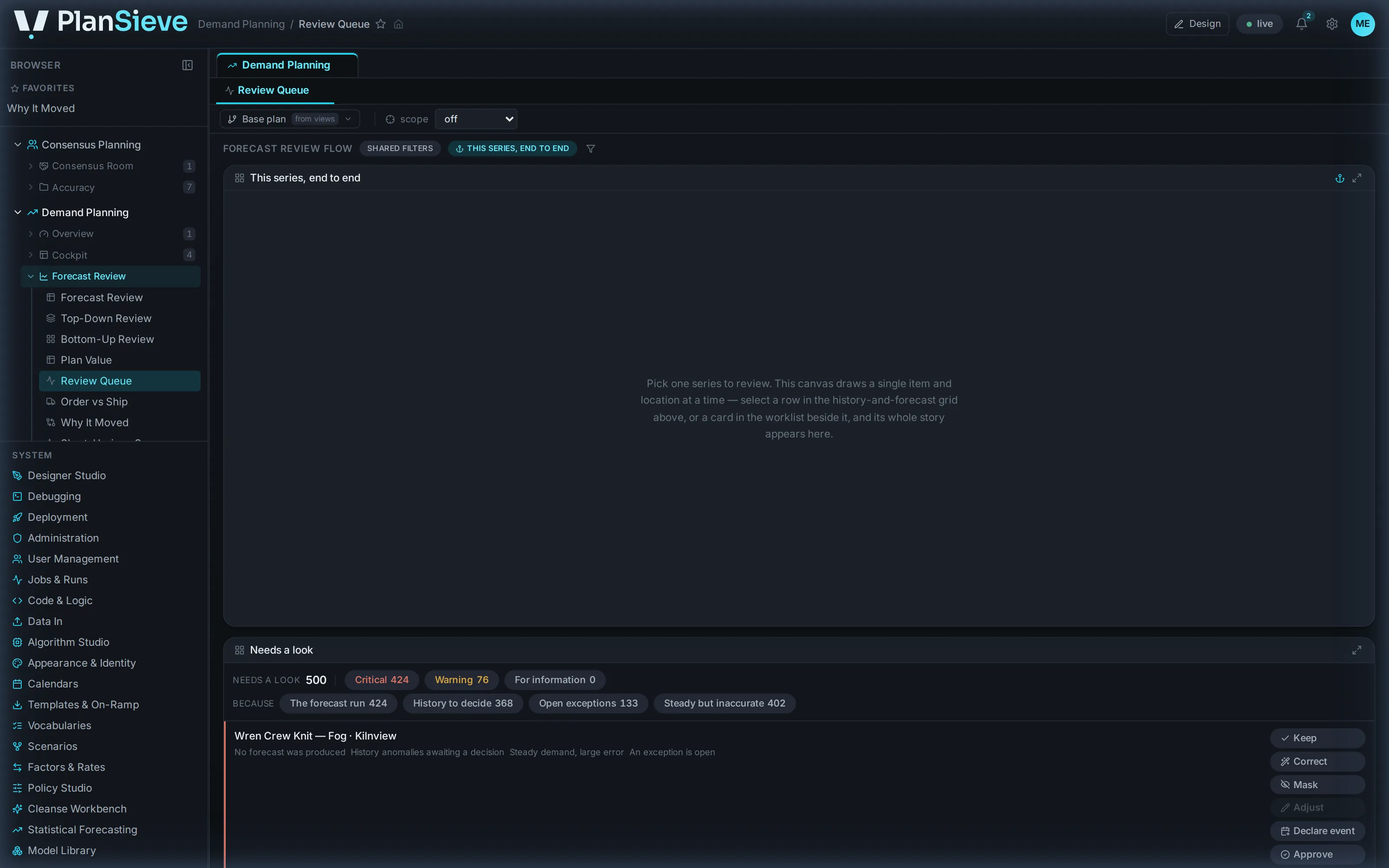
The morning worklist, a verdict in one gesture, a number that explains itself, and settings you own at the level you choose.
One gesture, and the whole plan hears you.
Keep it, correct it, mask it, or name it as an event, each a single click with the evidence beside it. The verdict is stored as data, not as a note, so the cleansing engine, the model contest and the next cycle all read it. A call you make once is a call the system keeps using, not an override it fights next cycle.
The mechanismEvery number can be asked why.
When someone asks why a number moved, right-click it and show them: the base, each driver’s push up or down, the model that won and by how much, and what changed since the last cycle. Where the arithmetic is exact you get a waterfall; where it is a proportional share, the page says so in words.
The mechanismEvery setting is yours, at the level you pick.
Cleansing, outlier treatment, stockout handling, launch curves, phase-out fences: each a switch with a dial, pinned at a category, a region, a channel or a single item. Set it once; everything underneath inherits it; one item can differ, with a reason. Off provably skips.
The mechanism


For the supply-chain leader
A plan you can let near a commitment.
A platform that grades its own work, a second module that costs the core nothing, and a what-if cheap enough to be a habit.
It will tell you when it was wrong. It will tell you when you were.
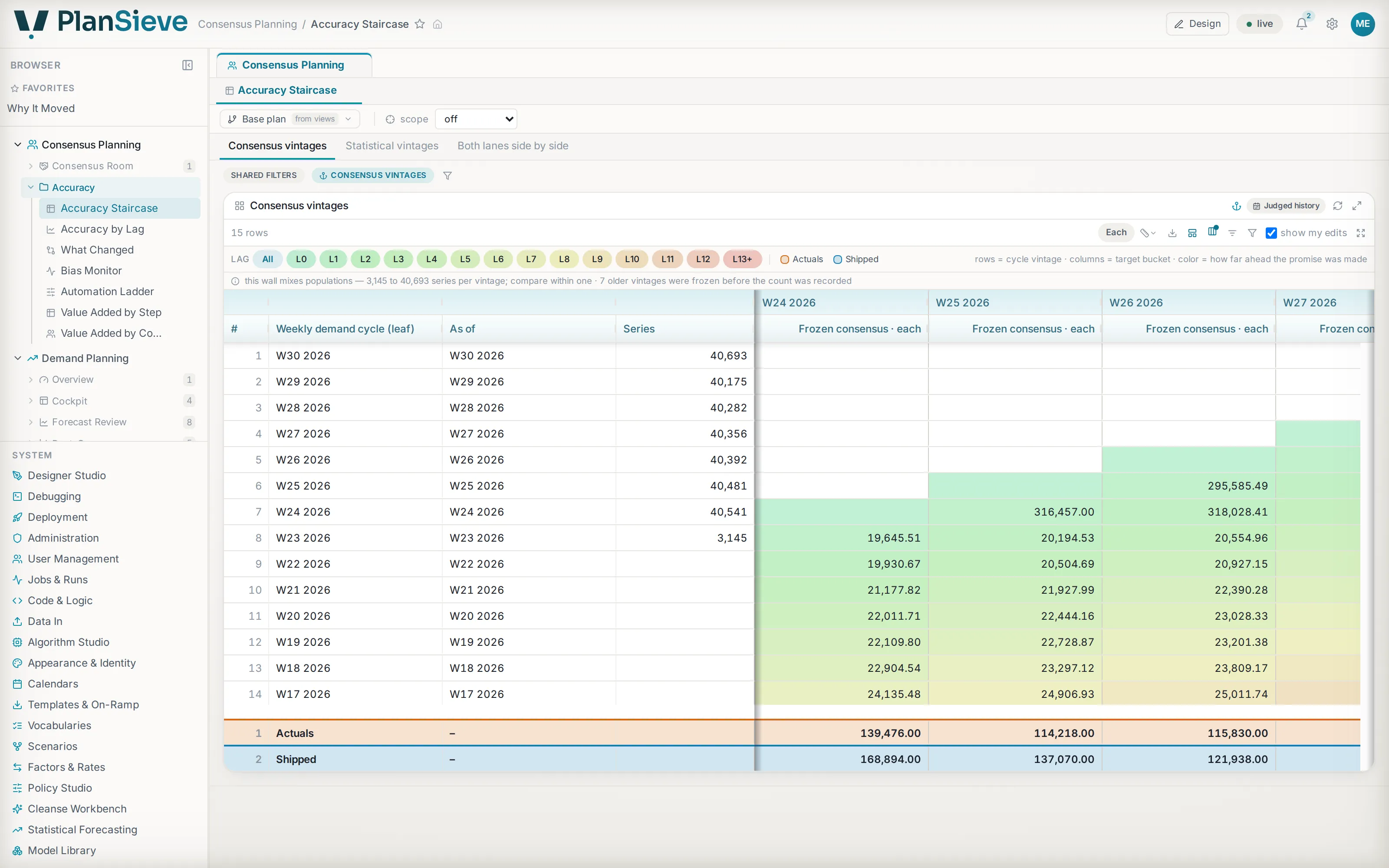
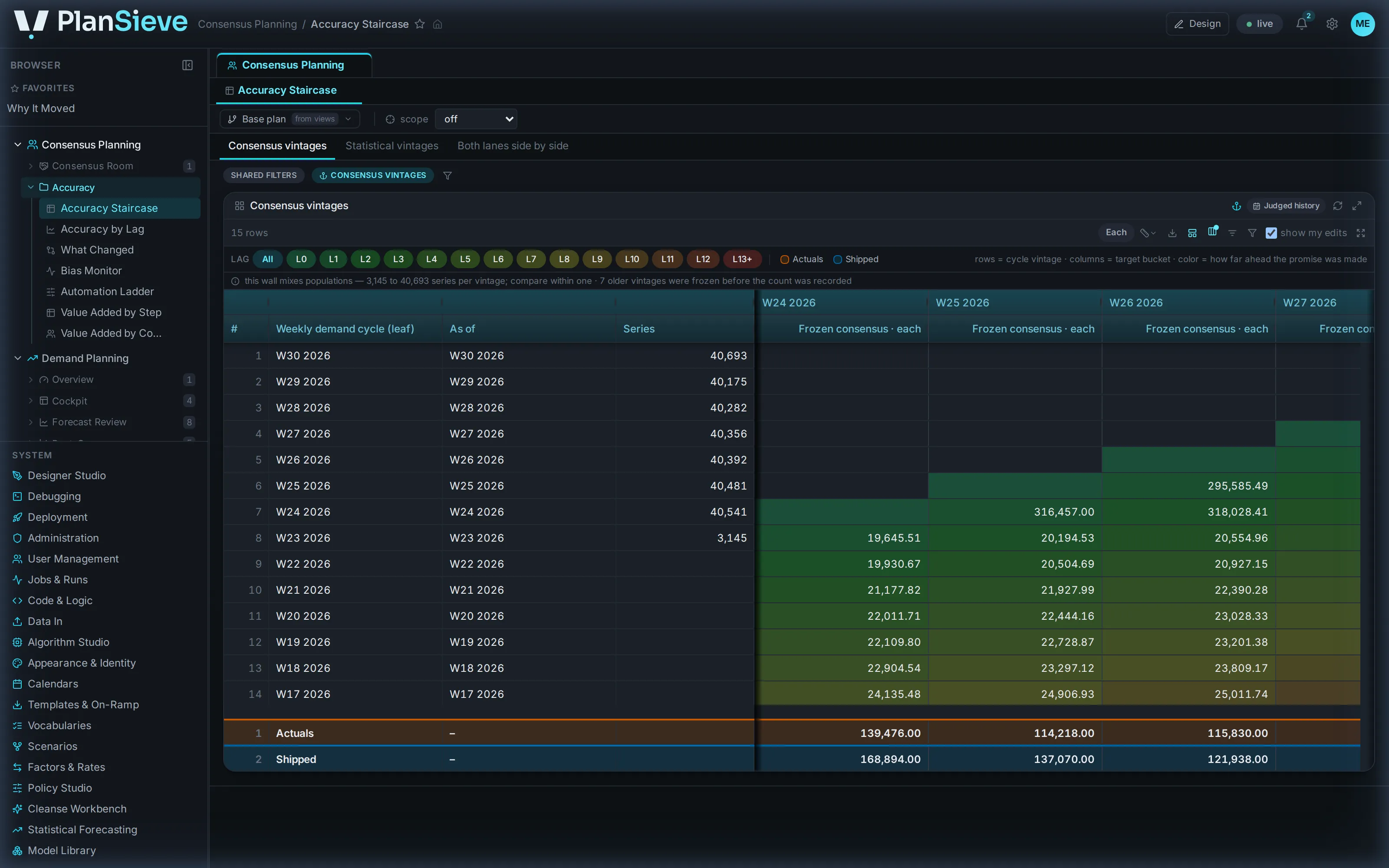
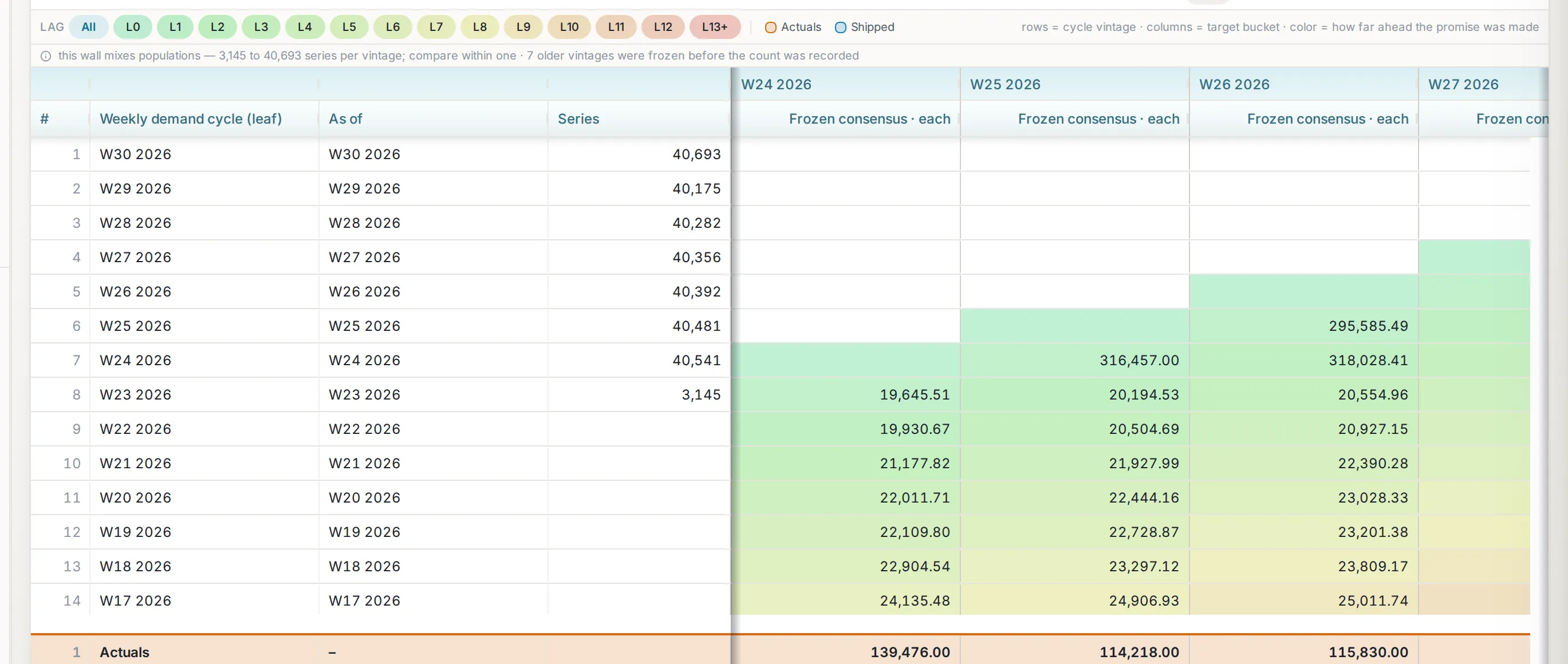
You get accuracy, bias and forecast value added every cycle, at whatever level you review, one definition on every screen, so the numbers in the room agree. When a manual change made the plan worse, the page shows that too, as a number. Authority earned with evidence is the only kind a planning system keeps.
The mechanismThe engine came first. The modules are configuration.
A planning module is a versioned package of metadata you activate, diff and upgrade, not a release you wait for. Demand ships today on exactly the same core that will carry inventory, supply and S&OP; we list a module as available only when it is.
The mechanismWhat-if, without the copy.
Ask the what-if in the meeting: a scenario holds only the cells you change, so it costs nothing to start or to throw away. Branch one off another, compare them side by side, and promote only the parts you want. Permissions still apply inside, and every promoted cell is re-checked.
The mechanism
For IT and data
One core, your storage, your model, every change on record.
Swappable storage behind one contract, isolation in the first line of the schema, your own models through the same door as ours, and configuration managed like code without being code.
One core, from a single site to a billion rows.
The fact store is an adapter, not a dependency: embedded columnar on a laptop, a scale-out column store in production, and a cloud-warehouse adapter designed behind the same contract, with a columnar interchange in between. Both engines return identical totals at both scales; one configuration value is the whole switch.
The mechanismPermissions that hold on every door.
Tenant isolation is enforced in the database itself: a connection that has not declared its tenant sees nothing and can write nothing. What a person may see narrows every grid, chart, run, export, scenario and explanation panel, by the same rule, with no side channels.
The mechanismYour model, our contest, one contract.
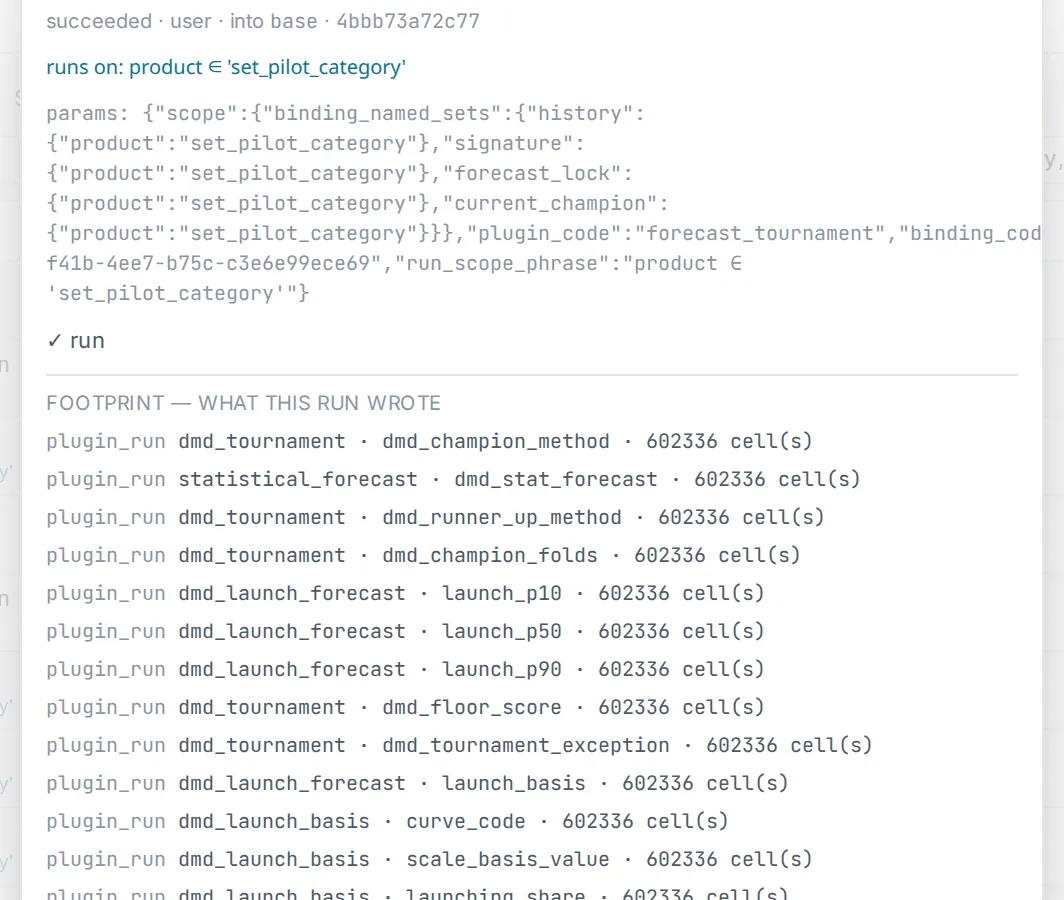
Register a model or a solver and it competes exactly as ours do: same inputs, same backtest, same accuracy definition, same lineage. It runs sandboxed, resource-limited and permissioned. Integration runs both ways at the platform level: inbound connectors, governed outbound publish.
The mechanismNothing changes without a record.
Configuration is versioned and diffable, plan edits carry who, when, what-from and what-to, and a published cycle is an immutable snapshot. Upgrades arrive as a three-way diff against your customisations, with conflicts named rather than overwritten.
The mechanism
See it in your role, on your data
Tell us which chair you sit in. We bring the walk that fits it, on your own history and hierarchies.
a working demo on your data · no commitment